Where Should a Floor Lamp Go in a Living Room? (Layout Guide)
Floor lamps generally go in one of four places: behind the sofa, beside an accent chair, in an empty corner, or beside a console. A practical placement guide for modern living rooms and apartments.
Knowing where to place a floor lamp in a living room usually comes down to four standard spots: behind a sofa, beside an accent chair or sectional, in an empty corner, or beside a console table. The right one depends on what the room is missing — light, balance, or both. Most living rooms have one obvious dark zone and one underused corner. The floor lamp usually belongs at the intersection of those two.
Placement matters more than the lamp itself. A well-chosen lamp in the wrong spot becomes furniture you walk around. A simple lamp in the right spot quietly fixes the room.
Quick answer:
Place a floor lamp in one of four standard spots: behind the sofa for ambient light over sectionals, beside an accent chair for reading and task lighting, in an empty corner for ambient fill in small apartments, or beside a console for layered lighting along a TV or feature wall.
For most modern apartments, the right placement is the one that lights the room's darkest zone while balancing its visual weight.
In this guide you'll learn:
✓ Best floor lamp placement for sectionals and floating sofas
✓ Where to place a floor lamp beside a reading chair
✓ How to choose the right spot in small apartments
✓ Common floor lamp placement mistakes to avoid
How to choose the right spot
Before deciding where the lamp goes, look at the room as a whole. Three questions tend to clarify the placement before the lamp itself enters the picture.
Where is the room darkest? Walk through the living room in the evening with only your existing lights on. The corner or zone that stays dimmest is usually where the floor lamp belongs. Overhead lights cast downward and rarely reach the far corners or behind seating. A floor lamp fills exactly the gaps overhead lighting leaves behind — the foundation of layered lighting in apartments.
Where does the eye stop moving? A balanced room has visual anchors at different heights — a tall plant, a console, a piece of art, a floor lamp. If one side of the room feels heavier than the other, the lamp usually goes on the lighter side to balance the composition. The lamp does double duty as light source and visual counterweight.
What's the room actually used for? A reading-focused living room wants task lighting beside the seating. An entertaining-focused room wants ambient light spread across the seating area. A small studio wants a single lamp doing both jobs. The use case decides which placement matters most.
Once those three questions are answered, the placement usually decides itself.
Placement matters more than the lamp itself. A well-chosen lamp in the wrong spot becomes furniture you walk around.
The four standard floor lamp placements
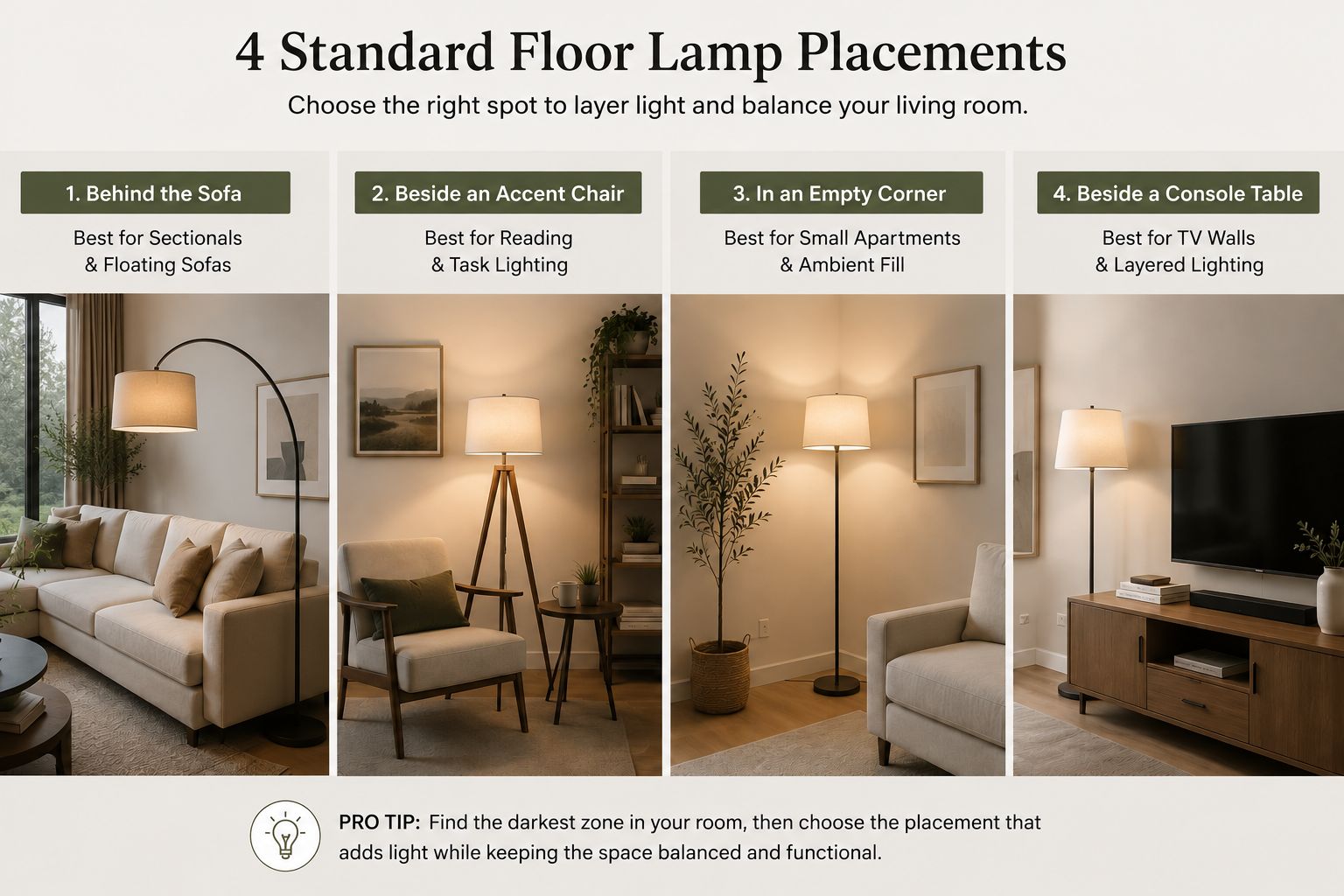
| Placement | Best For | Lamp Type | Main Goal |
|---|---|---|---|
| Behind Sofa | Sectionals | Arc Lamp | Ambient Light |
| Beside Accent Chair | Reading Areas | Tripod Lamp | Task Lighting |
| Empty Corner | Small Apartments | Slim Pole Lamp | Ambient Fill |
| Beside Console | TV Walls & Feature Walls | Slim Pole Lamp | Layered Lighting |
1. Behind the sofa
This placement works best for sectionals, floating sofas (sofas that don't sit against a wall), and any seating arrangement where the back of the sofa faces an open part of the room.
Arc lamps with a brushed brass or matte black arm tend to fit here naturally because the arm reaches over the cushions while the base sits off to the side. Slim pole lamps work when the sofa is pushed against a wall and there's a narrow gap behind. Tripod lamps generally don't fit — the wide base rarely tucks into the space behind most sofas.
The light from this placement spills over the seating from above, which is what makes the sofa feel finished. Without it, the seating area often reads slightly empty even when the rest of the room is well-lit. This is the placement that most often turns a functional living room into an intentional one.
For specific lamp recommendations and reach calculations for sectionals, our guide on Best Floor Lamps for Behind a Sofa goes deeper.
2. Beside an accent chair or open end of a sectional
This is the reading placement. The floor lamp stands beside a single chair or at the open end of an L-shaped sectional, with the shade landing at shoulder height when someone is seated.
The light from a floor lamp beside a chair is directional — it falls onto a book, a phone, a single seat — rather than ambient across the whole room. Choose a lamp with an adjustable head (gooseneck or swing-arm) if reading is the main use. A fixed linen drum shade works for general task lighting.
Walnut tripod lamps tend to anchor this placement well. The wide base signals "this corner is intentional" and visually grounds an accent chair that might otherwise float in the room. The choice between an Arc Floor Lamp vs Tripod Floor Lamp often comes down to whether the lamp is doing this job or the behind-the-sofa job.
3. In an empty corner
The corner placement is the most flexible and the most often misused. An empty corner with a floor lamp reads as intentional negative space. An empty corner with the wrong floor lamp reads as a lamp dumped where nothing else fit.
The difference is usually the surrounding context. A floor lamp in a corner generally needs at least one companion element to feel anchored — a plant, a small console, an art print on the adjacent wall, a sculptural object on the floor. The lamp shouldn't be the only thing in the corner.
Arc lamps overpower corner placement; their horizontal reach wants somewhere to go and a corner walls it in on two sides. Slim pole lamps and tripod lamps work better in corners because they read as vertical anchors rather than sculptural reaches.
Use the corner placement when the room needs ambient fill or when one side feels visually lighter than the other. In a small apartment, this is often the placement that does the most work for the least floor space. Skip it if the corner is already populated with furniture — adding a lamp to a busy corner crowds the eye.
4. Beside a console table or media unit
The console placement layers floor lamp light with the table itself and whatever sits on it. A slim brushed brass floor lamp standing next to a walnut media console with a table lamp on top creates two light sources at different heights — exactly the layered lighting that makes a living room feel finished rather than functional.
This placement works best with slim pole lamps. The lamp acts as a vertical companion to the console rather than competing with it. Avoid arc lamps here — the arm reaching over the console crowds whatever sits on the surface.
The console placement also tends to anchor a TV wall or a long feature wall. A media unit alone can read flat against a long wall. Adding a floor lamp beside it adds vertical interest and softens the rectangle of the screen.
Layout-specific guidance
Floor plans tend to fall into four common living room shapes. Each one has a default placement and a secondary option.
Open-plan apartment with a floating sofa. Default: behind the sofa with an arc lamp. Secondary: beside an accent chair at the conversation area. The floating sofa creates the room's primary lighting need — the back of the sofa faces an unlit zone, which the arc lamp fills.
Galley living room (long and narrow). Default: in the far corner past the seating. Secondary: beside the sofa at the far end. Galley rooms benefit from drawing the eye toward the back of the room, which a lit corner does naturally. Avoid putting the lamp near the entry — it pulls attention toward the wrong end. Watch the traffic path: galley rooms have one walking line down the middle, and the lamp belongs outside it.
L-shaped living room with a sectional. Default: arc lamp at the open end of the L. Secondary: tripod lamp beside the accent chair if there's a reading corner. The open end of the L is the room's natural lighting weak point; the corner where the L closes already has wall light.
Living room with sofa against the wall, accent chair across. Default: tripod lamp beside the accent chair. Secondary: slim pole lamp behind the sofa if the wall is interior (not against a window). The accent chair tends to anchor the room when lit, and the placement creates a diagonal pull of light across the conversation area.
Find the room's darkest zone and its underused corner. The floor lamp belongs at the intersection of those two.
Common placement mistakes
Putting the lamp in the only spot you have, not the spot the room needs. This is the most common mistake in small apartments. The lamp ends up in the one corner that was already empty, regardless of whether the corner needed light. The result is a lamp that lights an unused part of the room while the actual seating stays dim.
Placing two floor lamps symmetrically. Symmetrical floor lamp placement reads stiff and formal in modern apartments. Living rooms generally feel warmer with asymmetric lighting — one floor lamp, one table lamp, one wall sconce — at different heights. Save symmetry for traditional rooms with clear central axes.
Blocking the traffic path. A floor lamp in a walkway gets knocked, gets unplugged, and eventually gets moved to a worse spot. Map the foot traffic between the seating, the entry, and any doorways before deciding placement. The lamp goes outside those lines, with at least 18–24 inches of clearance from regular walking routes.
Choosing placement before measuring the cord. Floor lamps need to reach an outlet. The most beautiful placement is useless if the cord runs across the rug or pulls taut at an angle. Measure the distance from the proposed placement to the nearest outlet before committing.
Match placement to use, then verify the cord run.
Designer Tip
Turn off the overhead lights at night and walk slowly through the room. The zone that feels visually underlit — usually a corner, a sofa back, or the gap beside a console — is almost always where a floor lamp will have the greatest impact. Trust the dark spot more than the floor plan.
Explore Floor Lamps for Modern Apartments
Browse the Zenvra Lighting Collection →
FAQ
Where should a floor lamp go in a small living room? Beside the seating, not in a corner. Small living rooms tend to feel cramped when furniture and lamps both compete for corner space. Placing the floor lamp beside the sofa or accent chair lights an active zone and keeps the corner open as visual breathing room.
Can a floor lamp go in the middle of a living room? Usually not, unless the room has a floating sectional or conversation pit. A floor lamp in the middle of a room blocks sight lines and traffic paths. Arc lamps solve this by reaching into the middle from a base at the perimeter.
Should a floor lamp go behind or beside a sofa? Behind a sofa works for sectionals and floating sofas that need ambient light spilling onto the cushions. Beside a sofa works when the sofa is pushed against a wall, or when the lamp is doing task work for a single seat. Either placement is correct in the right context.
How far should a floor lamp be from a sofa? About 6 to 12 inches from the sofa frame for behind-the-sofa placement — close enough for the shade to hang over the seating, far enough not to get knocked. For beside-the-sofa placement, 4 to 8 inches from the sofa arm works because there's no horizontal clearance issue.
Should every living room have a floor lamp? Most living rooms benefit from one, especially apartments without overhead lighting or with limited ceiling fixtures. Floor lamps fill the gap between overhead light and table lamps — the layered lighting that makes a room feel intentional. Skip the floor lamp only if the room already has strong layered lighting from sconces, table lamps, and overheads.
Where should I place a floor lamp if I have low ceilings? In a corner or beside the seating rather than in the open middle of the room. Low ceilings under 8 feet make tall lamps feel imposing when placed centrally. Tucking the lamp against a wall or beside furniture lets the height read as architectural rather than crowding.
Bottom line
Where a floor lamp goes depends less on a fixed rule and more on what the room is missing. Find the darkest zone and the underused corner. Check what the room is used for. Then choose the placement that fixes both at once.
For most modern apartments, that means behind a sofa for ambient overhead light, beside an accent chair for reading, in a corner for visual balance, or beside a console for layered lighting. Any of the four can be the right answer — the room itself decides which.