How Tall Should a Floor Lamp Be? Living Room, Sofa & Reading Guide
Floor lamps generally stand 58-72 inches tall, with the shade above seated eye level. A room-by-room guide to height ranges for living rooms, sofas, reading chairs, and bedrooms.
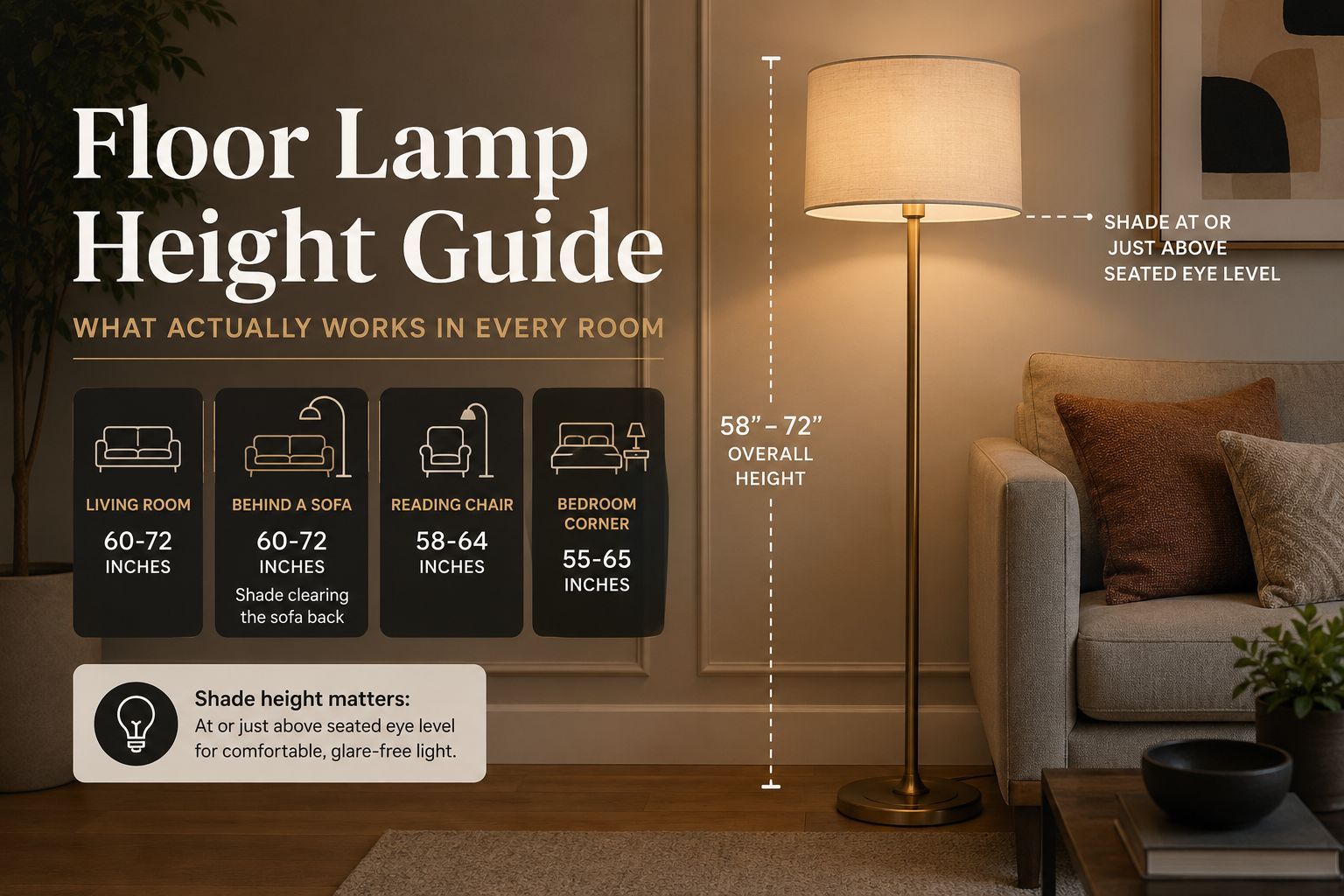
A floor lamp should generally stand between 58 and 72 inches tall, with the shade sitting at or just above seated eye level. The exact number depends on what the lamp is doing — anchoring a sofa, lighting a reading chair, filling a bedroom corner, or replacing missing overhead light. The same lamp at the same height can read perfectly in one room and feel wrong in another.
Most floor lamps fall short of their job for one reason: the shade ends up at eye level when someone sits down, putting the bulb directly in their line of sight. Height isn't really a style decision. It's a placement decision.
Quick answer:
- Living room: 60-72 inches
- Behind a sofa: 60-72 inches, with the shade clearing the sofa back
- Reading chair: 58-64 inches
- Bedroom corner: 55-65 inches
How floor lamp height actually works
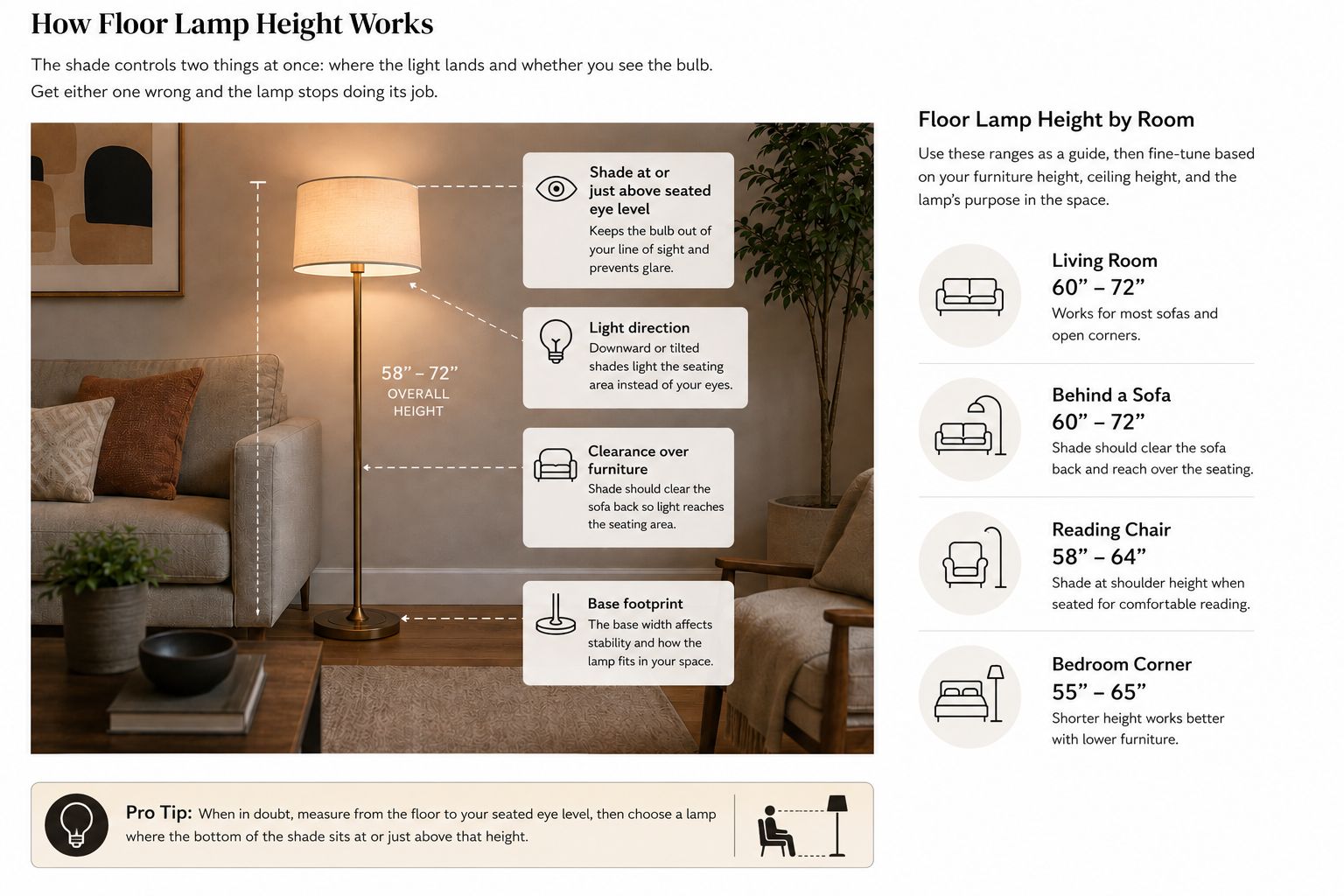
The shade controls two things at once: where the light lands and whether you see the bulb. Get either one wrong and the lamp stops doing its job.
Eye level when seated. This is the measurement most people skip. The bottom of the shade should sit just above the line of sight of someone sitting opposite. Below that, the bulb glares into their eyes. Higher than a few inches above, the light feels too distant to warm the seat.
Light direction. A drum shade or downward-tilted shade projects light onto the seating area. An open-top shade or torchiere bounces light off the ceiling. Both have their place, but they want different heights. Downward-facing shades work in the standard 60-72 inch range. Ceiling-bounce shades typically need to stand taller to give the bounce enough distance to soften.
Clearance over furniture. A floor lamp beside or behind a sofa needs to clear the sofa back with enough room above for the shade to project light onto the cushion. The shade should sit comfortably above the sofa back so light reaches the seating area rather than disappearing behind furniture. This is generally why 58 inches is the practical floor for living room lamps — anything shorter starts fighting the sofa back instead of working with it.
Base footprint. Height doesn't exist in isolation. A tall lamp with a wide tripod base reads differently in a small apartment than a tall slim arc with a compact disc base. Tall and wide pulls the eye toward the lamp. Tall and slim lets it recede into the room.
Shade height tends to influence comfort more than most people expect.
Room-by-room guide
Living room: 60-72 inches
This is the standard range and where most floor lamps land. A 65-inch lamp beside a sofa or in an open corner gives ambient light at a height that feels intentional rather than imposing.
The exact number inside the range depends on your seating. Low-profile sectionals with shorter arms want a lamp on the lower end. Traditional sofas with taller arms want the upper end. The visual rule: the shade should sit roughly at the height of a standing person's mid-chest when you walk past it. That tends to put it at the right level for someone seated nearby.
Pair the lamp with a 2700K-3000K warm white bulb. Cooler temperatures break the living room mood.
Behind a sofa: 60-72 inches, with the shade clearing the sofa back
This is the most demanding placement. The lamp has to clear the sofa back, project light forward onto the seat (not down into the sofa back itself), and keep the bulb above eye level for anyone sitting on the opposite end.
Arc lamps usually win here because the shade hangs over the cushion while the base sits off to the side. Slim pole lamps work when the sofa is pushed against a wall and there's a narrow gap behind. Tripod lamps generally don't fit — the wide base rarely sits in the space behind most sofas.
Our guide on Best Floor Lamps for Behind a Sofa covers placement scenarios, shade angles, and the practical reach calculations for sectionals and floating sofas.
Reading corner: 58-64 inches
A reading floor lamp stands beside an accent chair or at the open end of a sectional. The shade should sit at shoulder height when you're seated — high enough to spill light onto the page, low enough to feel close rather than overhead.
Light should fall over the reader's shoulder onto the book, not into their face. Adjustable heads — gooseneck or swing-arm — give you control over the angle without moving the lamp. Choose a downward-tilted drum shade, not an open-top design. Reading light should be directional, not ambient.
Bedroom: 55-65 inches
Bedroom floor lamps run shorter because the furniture runs shorter. Platform beds and low dressers don't need a tall lamp standing beside them — the proportions read top-heavy. Aim for 55-65 inches in most bedrooms.
A bedroom reading chair follows the reading corner rules above. A corner lamp meant only for ambient fill can run shorter still. Use 2200K-2700K bulbs in bedrooms; the warmer temperature reads as evening rather than workspace.
Common floor lamp mistakes
The lamp is too short. A lamp that ends just below the sofa back puts the bulb at seated eye level for anyone across the room. It ends up turned off most of the time because the glare is uncomfortable. Match the height to the furniture first, then pick the style.
The lamp is too tall. An oversized arc or torchiere in a room with standard apartment ceilings often feels like it's pushing the ceiling down. Tall lamps tend to need taller ceilings to read as proportional. In most apartments, 72 inches is a comfortable upper limit unless the lamp has a deliberately architectural intent.
The bulb sits at eye level. This is the most common failure across all heights. A correctly-sized lamp with a shallow shade can still expose the bulb if the bottom of the filament peeks out. Check the shade depth before buying — the bulb should be invisible to a seated viewer from any angle.
The base is too wide for the room. A tripod base reads fine in an open living room and often feels cramped in a small apartment. Slim disc bases and arc lamp bases set off to the side leave more visual room. If the lamp is the right height but feels too big, it's usually the base, not the pole.
The choice between an Arc Floor Lamp vs Tripod Floor Lamp often comes down to base footprint as much as height. The right height in the wrong shape still crowds the room.
Match height to use, base to room.
Explore Modern Lighting
Browse floor lamps designed for apartment living rooms, reading corners, and everyday spaces that need softer, warmer light.
FAQ
How tall should a floor lamp be beside a sofa? Generally 60-72 inches for a standard sofa. The shade should sit comfortably above the sofa back so light projects onto the cushion rather than into the upholstery. For a low-profile sectional with shorter arms, the lower end of the range usually fits better.
How tall should a floor lamp be for reading? 58-64 inches beside a reading chair. The bottom of the shade should land at the reader's shoulder height when seated — high enough to spill onto the page, low enough to feel close. Adjustable heads (gooseneck or swing-arm) give finer control over the light angle.
Can a floor lamp be taller than a couch? Yes, and it usually should be. A floor lamp beside or behind a sofa should rise comfortably above the sofa back to project light onto the seat instead of into the upholstery. The exception is a torchiere designed to bounce light off the ceiling — those tend to work taller but rely on ceiling height for the bounce.
What's the ideal floor lamp height for a bedroom? 55-65 inches works for most bedrooms. Furniture runs shorter — platform beds, low dressers — so a tall lamp can feel oversized. A bedroom reading chair follows the reading corner range (58-64 inches). A soft corner lamp meant for ambient fill can run shorter.
Does floor lamp height depend on ceiling height? In standard apartment ceilings, the practical range stays 58-72 inches regardless. Ceiling height matters more for arc lamps and torchieres: taller ceilings can support taller lamps, while standard ceilings generally cap comfortably around 72 inches.
Should floor lamp height match other lamps in the room? The shades should sit at similar visual heights when viewed across the room, not the lamps themselves. A floor lamp and a table lamp on a console can land their shades at roughly the same level — that tends to be the consistency that makes a layered lighting setup look intentional.
Bottom line
The right height depends less on the lamp itself and more on the room around it. Start with furniture placement first, then choose a lamp height that feels comfortable when you're seated.
For most modern apartments, that means a 60-72 inch lamp beside a sofa, 58-64 inches beside a reading chair, and 55-65 inches in a bedroom corner. Pair with a warm bulb — 2700K-3000K for living rooms, 2200K-2700K for bedrooms — and a shade that hides the bulb from seated viewers.
The right height makes the lamp disappear into the room. The wrong height makes you stop turning it on.