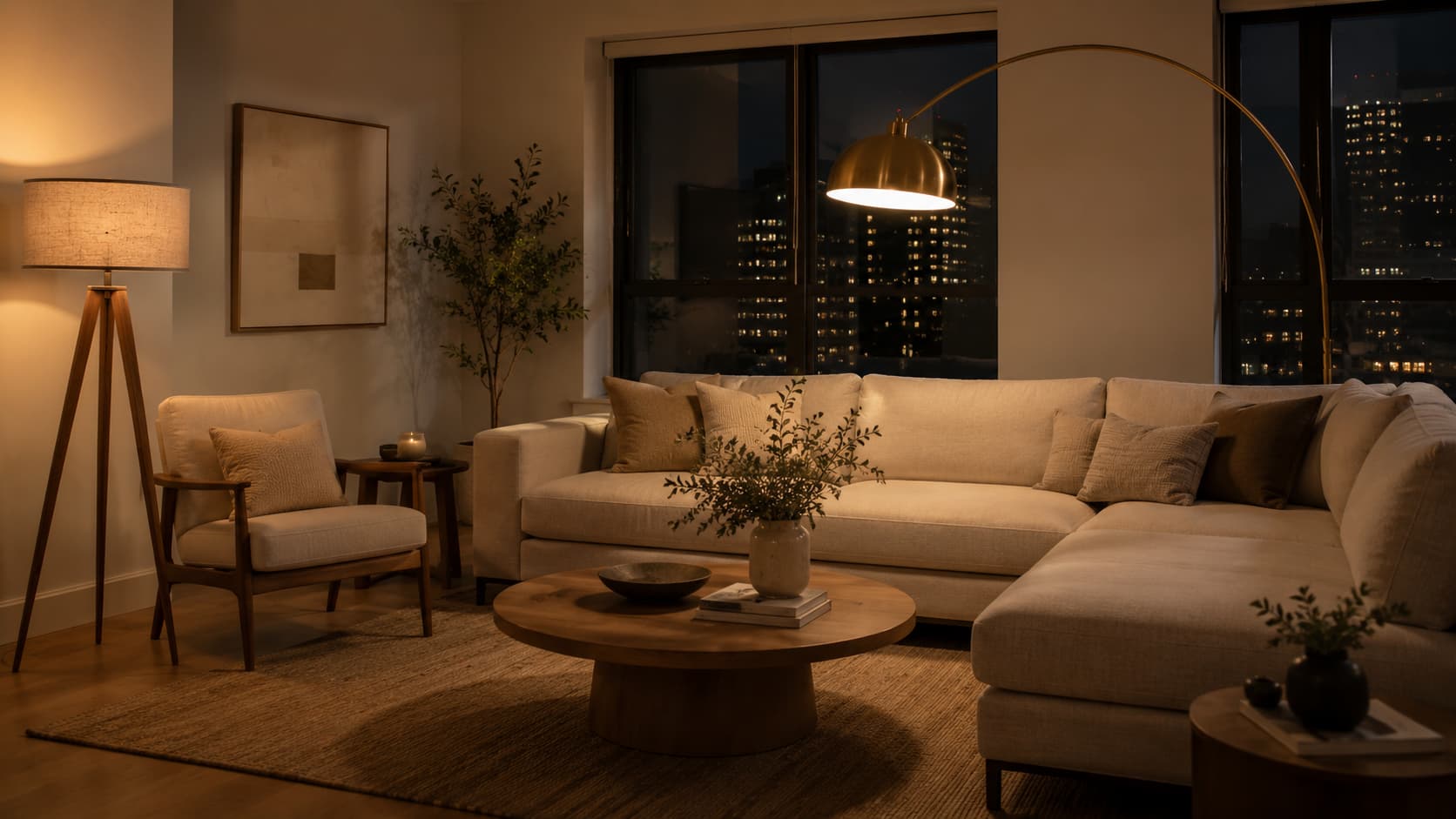
Arc Floor Lamp vs Tripod Floor Lamp (How to Choose)
Arc lamps reach over sectionals and floating sofas. Tripod lamps anchor beside wall-pushed sofas and reading chairs. Here's how to pick the right one for your apartment
An arc floor lamp and a tripod floor lamp can completely change how a room feels — but they solve different problems. Arc lamps reach over your seating, suspending light where a base couldn't physically sit. Tripod lamps anchor beside furniture, spreading soft ambient light from the floor up. The right choice usually comes down to a single question: where is your sofa, and what's the gap around it?
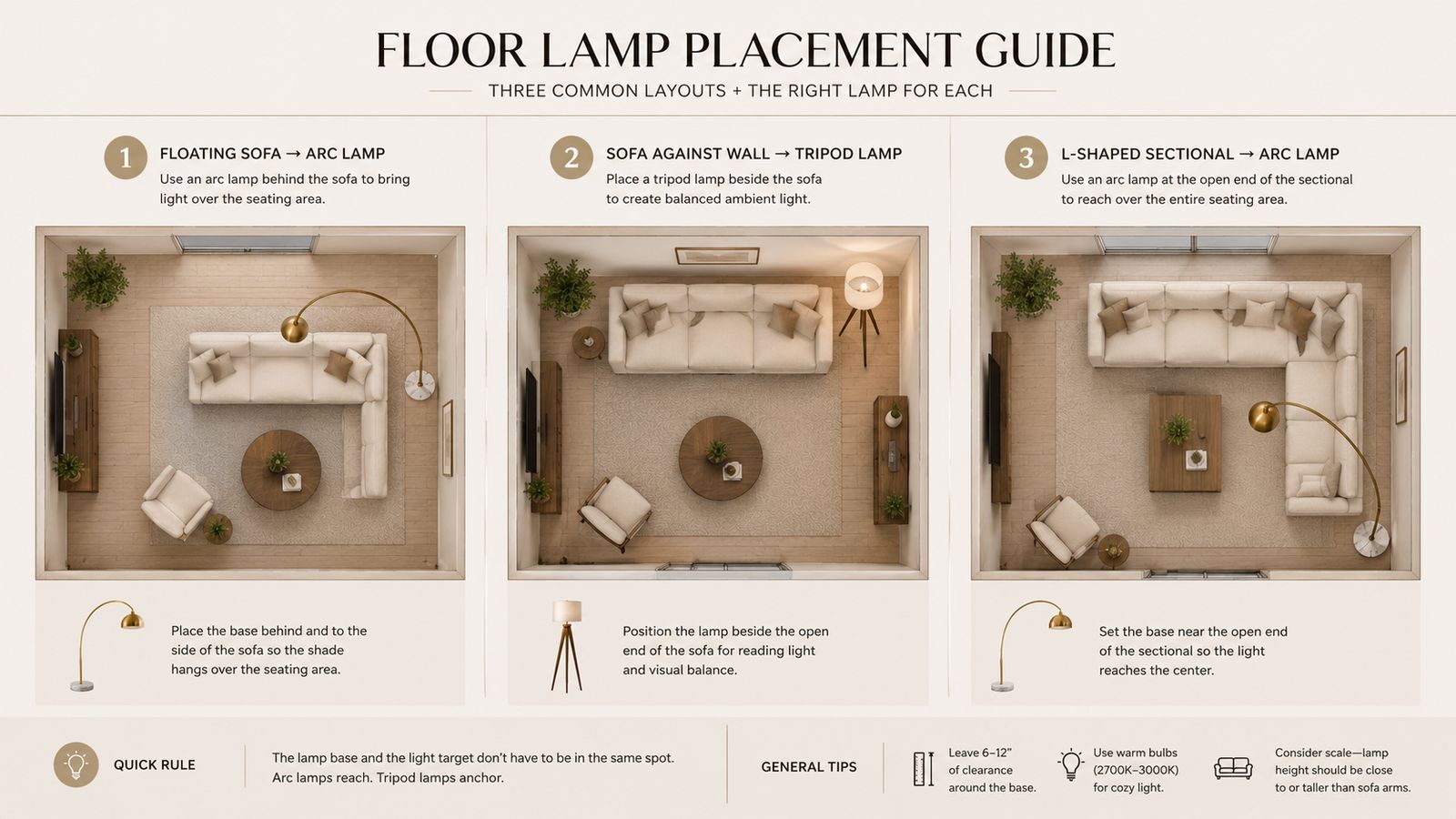
Quick answer: if your sofa floats away from the wall or you have an L-shaped sectional, choose an arc lamp. If your sofa is pushed against a wall with open space at one end, choose a tripod.
The structural difference (and why it matters)
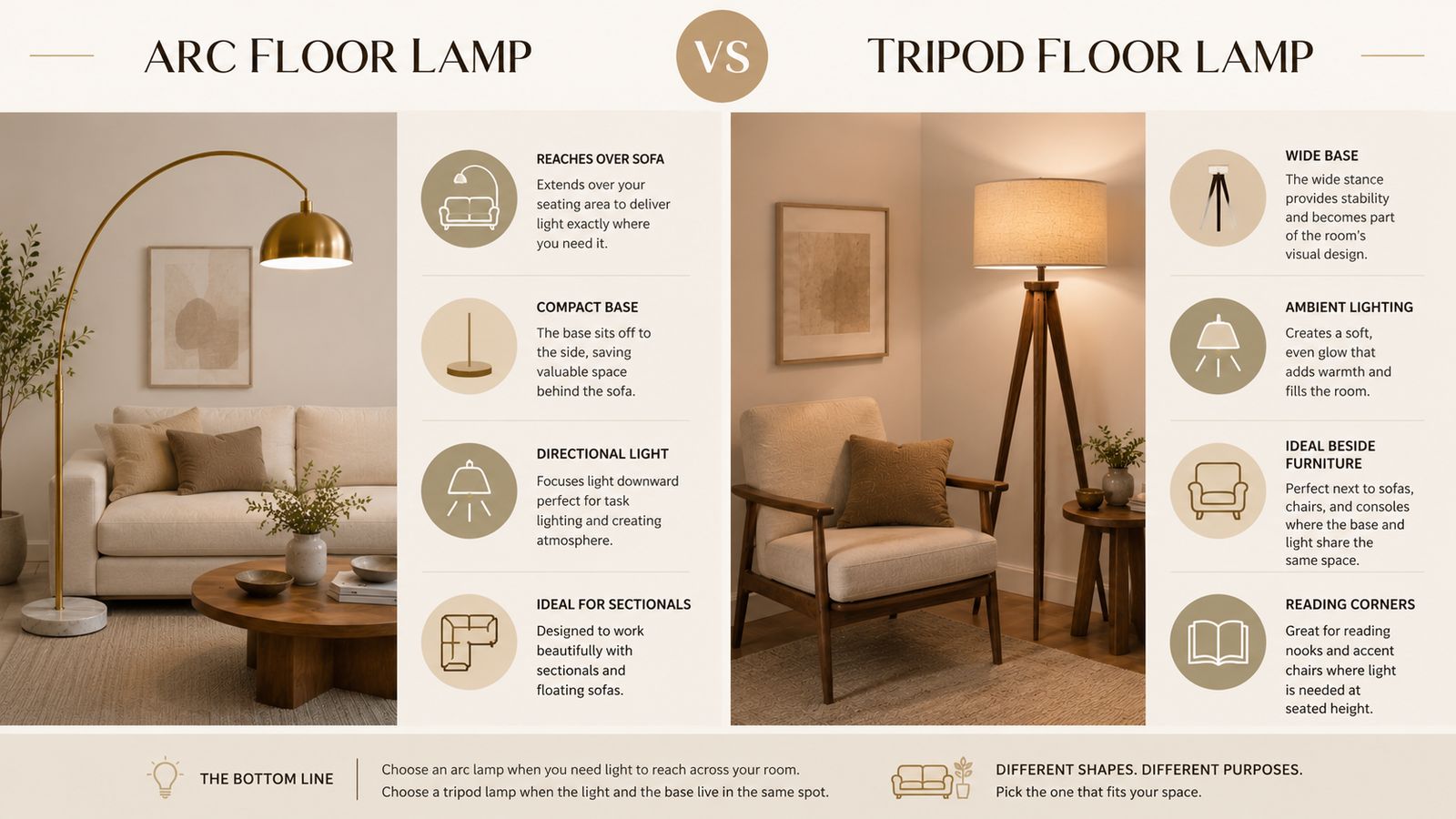
An arc floor lamp has a heavy weighted base — usually marble or solid metal — and a curved arm that extends horizontally into the room. The shade hangs from the end of the arm, suspended over wherever you place it. The base sits well off to the side of where the light actually lands.
A tripod floor lamp is the opposite shape entirely. Three legs splay outward from a central pole, and the shade sits directly above them. There's no horizontal reach — light falls straight down from where the lamp stands.
This difference decides almost everything else. Arc lamps put light somewhere the base can't physically be. Tripod lamps commit to a placement and stay there. Tripod lamps tend to work best beside furniture rather than behind it because their wider base becomes part of the room layout itself — they read as part of the seating arrangement rather than a fixture tucked into a corner.
Side-by-side comparison
| Arc floor lamp | Tripod floor lamp | |
|---|---|---|
| Typical height | 65-80 in | 55-65 in |
| Horizontal reach | 30-50 in | None |
| Best for | Sectionals, floating sofas, open-plan apartments | Beside sofas, reading corners, accent chairs |
| Best decor styles | Mid-century modern, contemporary minimalist, modern coastal | Japandi, mid-century modern, Scandinavian, organic modern |
| Light pattern | Directional, downward over a target | Ambient, spread below the shade |
| Tips over easily | Lower risk (weighted base) | Slightly higher if knocked |
The most important row is "horizontal reach." If you need light somewhere your base can't sit — over a sofa cushion, above a coffee table, in the middle of an L-shaped sectional — only the arc lamp does that. If your light target and your floor space are the same spot, a tripod works.
When to choose an arc floor lamp
Arc lamps tend to work well in four situations:
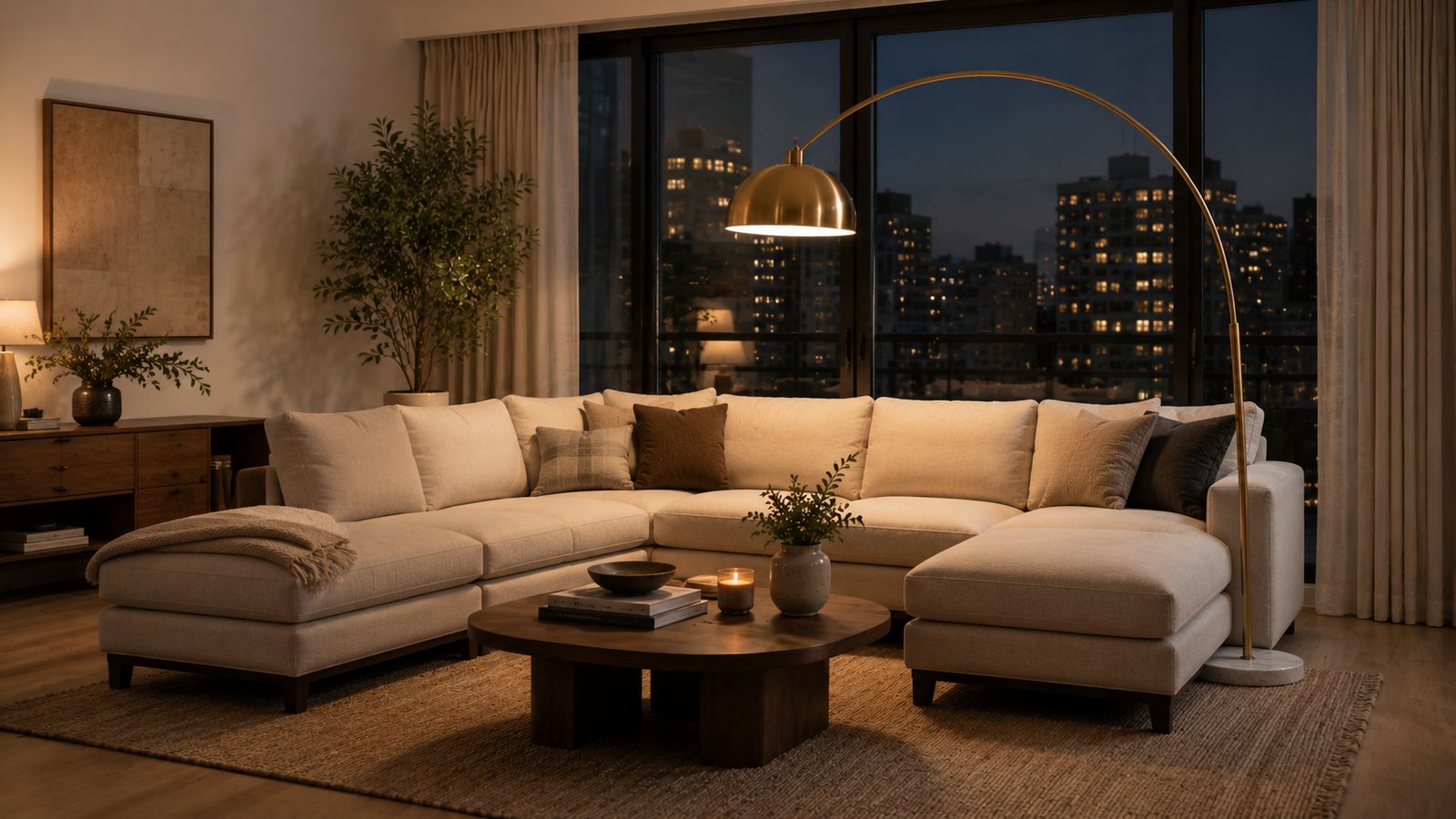
Behind a sectional or floating sofa. Arc lamps were essentially designed for this. The arm reaches over the seating area while the base stays out of the traffic path. The shade lands directly over a cushion without needing a side table. If you're deciding specifically for sofa placement, our guide on Best Floor Lamps for Behind a Sofa explains layout considerations in more detail.
Open-plan apartments with no overhead lighting. Rentals often have one ceiling light per room — usually in the wrong place. An arc lamp with a warm 2700K-3000K bulb substitutes for a ceiling fixture. The shade height lands roughly where a pendant would hang, which is the geometry that makes overhead light feel natural.
Reading corners where you can't add a side table. Arc lamps put light over a chair without occupying the floor space next to it. The base sits a few feet away; the shade hangs directly over the book.
Rooms with high ceilings. A taller arc lamp fills vertical space that shorter lamps can't reach. In an apartment with 9-foot ceilings, the arc reads as architectural rather than decorative.
The downside: arc lamps need horizontal clearance you might not have. An arm pointed toward a wall is useless — it has to swing into the room. Measure from where the base would sit to where you want the shade to land before you buy.
When to choose a tripod floor lamp
Tripod lamps generally work well in three situations:
Beside a sofa pushed against a wall. The base sits on the floor next to the sofa arm, not behind it. Light falls onto the cushion from the side, not overhead. This is the standard living room corner setup — a tripod next to one end of a wall-mounted sofa, balanced by a side table or accent chair on the other end.
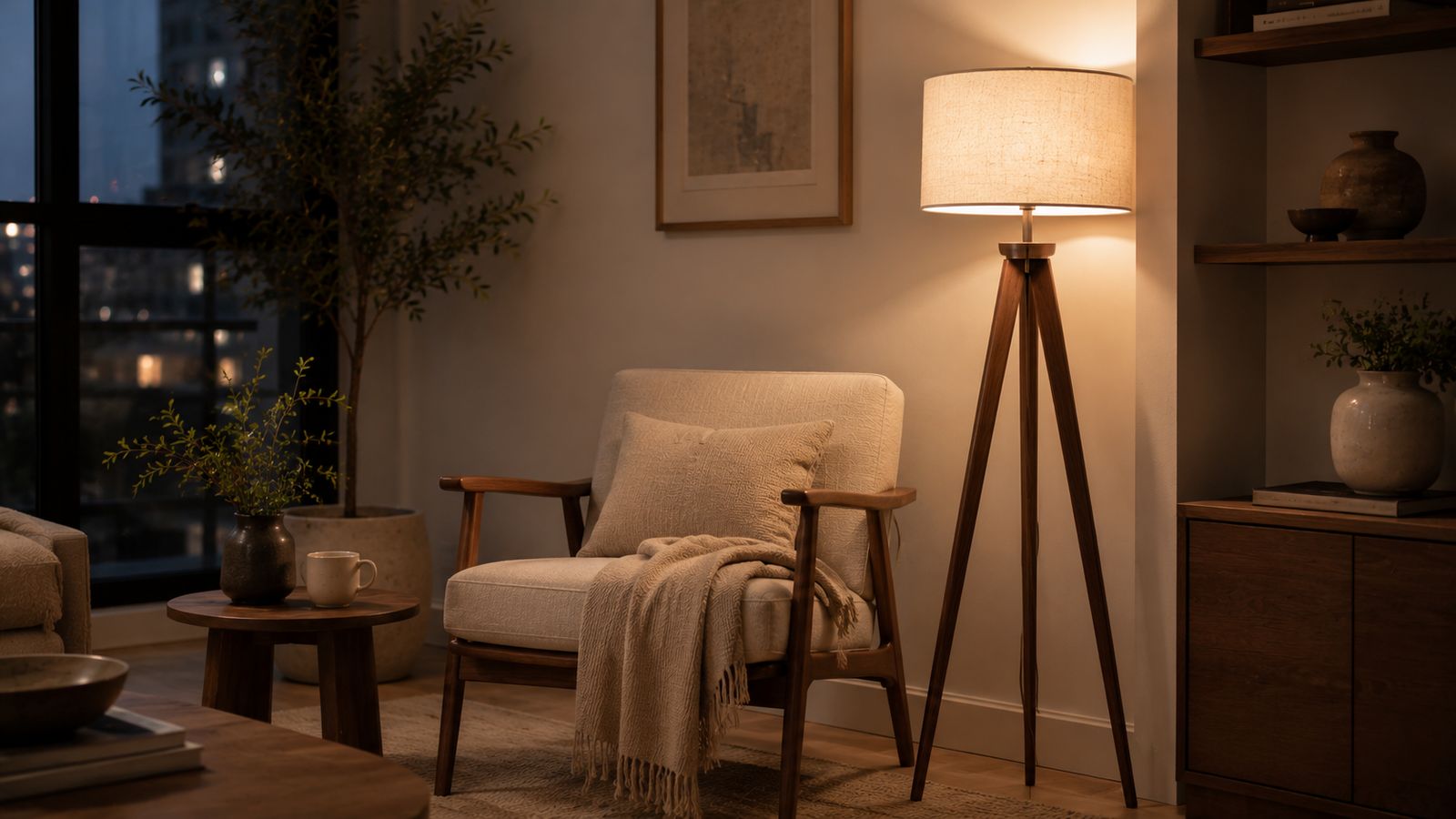
Reading nooks with an accent chair. A tripod beside a reading chair puts the shade at seated eye level. Light spills over the shoulder onto the book. The wide base also signals "this corner is intentional" — it anchors a chair that would otherwise float in the room.
Mid-century modern, Japandi, and Scandinavian rooms. Tripod lamps with walnut legs and a linen or cream fabric shade are the lighting equivalent of a teak credenza. They belong in rooms with low-profile furniture, exposed wood, and neutral palettes. Pair a walnut tripod with a linen sectional and the styling is immediate.
The downside: tripods take up real floor space. The wider base means you can't tuck one into a tight corner. In a galley living room or a studio under 400 square feet, this becomes a problem fast.
How to decide for your specific room
Three questions, in order:
1. Where is your sofa?
- Against a wall: tripod beside the open end, or an arc that reaches over the front cushion from the side
- Floating in the room: arc behind the sofa
- L-shaped sectional: arc at the open end of the L, base off to the side
2. How much clearance do you have around the sofa?
- Tight clearance behind, open space beside: tripod
- Some clearance behind, room for an arm to swing in: arc
- Open floor on all sides: either works — pick on style
3. What's your existing decor anchor?
- Walnut, linen, low-profile, organic shapes: tripod with walnut legs
- Brass, marble, sleek silhouettes: arc with brushed brass or matte black arm
- Mixed: prioritize placement over style
If two of three answers point to one type, that's your answer.
Mistakes to avoid with either choice
Buying a tripod for behind a sofa. This is one of the most common mistakes in apartment lighting. The wide base usually doesn't fit in the narrow gap behind most sofas, so the lamp ends up beside the sofa instead — which means light falls in the wrong place and the legs stick into the walking path.
Buying an arc lamp without measuring the reach. A short arm doesn't reach as far as it looks. If your sofa is deep and the base has to sit behind it, the shade can end up hovering over the sofa back rather than the cushion. Measure first.
Mixing two arc lamps in one room. Two arc lamps tend to fight each other visually. The curves compete. One arc lamp plus one table lamp on a console usually works; two arcs usually doesn't.
Choosing based on the photo on the product page. Stock photography usually shows lamps in showroom-sized rooms with high ceilings. Your apartment is probably different. Check the actual dimensions in the spec sheet, not the styled photo.
Explore Modern Lighting
Browse floor lamps designed for apartment living rooms, reading corners, and contemporary spaces.
FAQ
Are arc floor lamps too dramatic for small apartments? Usually not. The horizontal reach is the point — the base stays out of the traffic path while the light hits the center of the room. A 65-inch arc lamp generally works in a 10x12 living room as long as the arm orients into the room, not toward a wall. Arc lamps may feel cramped only when the ceiling is under 8 feet.
Are tripod lamps stable enough for households with pets or kids? The three-leg base is generally more stable than a single-pole lamp, though arc lamps with weighted marble bases often offer the most tip-resistant design overall. Both work in pet households — arc lamps just tend to have a slight edge.
Can either type replace overhead lighting in a rental? Often yes — an arc lamp with a 2700K-3000K warm white bulb can substitute for a ceiling fixture in many layouts. Tripod lamps with diffused linen shades work for ambient fill but usually won't fully replace overhead light. You'll generally need a second source.
Which is more apartment-friendly long term? Arc lamps often adapt more easily across different layouts because the light placement is separate from the base position. Tripod lamps tend to be more committed — they decide their spot and stay there.
Do arc lamps need a specific bulb type? Most use E26 standard sockets and pair well with 2700K-3000K warm white bulbs for living rooms. Smart bulbs generally work fine and give you dimming without rewiring.
Which holds value better long term? Both, when you buy quality. The deciding factor usually isn't arc vs tripod — it's materials. A solid brass arc lamp and a solid walnut tripod will generally outlive a flat-pack version of either. Avoid hollow-tube metals and veneer-over-MDF.
Bottom line
Arc lamps solve placement problems. Tripod lamps anchor placements you've already chosen.
The better choice depends less on style and more on placement. Choose the lamp that fits your room layout first — aesthetics come second.
If you have a sectional, a floating sofa, or no overhead lighting, an arc lamp often fits naturally. If you have a sofa against a wall with open space at one end, or a reading chair that needs a sculptural anchor, a tripod often makes more sense. When your room and your style preference pull in different directions, prioritize placement — a beautiful lamp in the wrong spot stays beautiful and unused.