Modern Corner TV Stand Buying Guide (What to Look For)
A modern corner TV stand opens a wall, expands viewing angles, and makes small rooms feel larger. A practical buying guide covering sizing, materials, storage, and cable management for modern apartments.
Researched and curated by the Zenvra Home editorial team. Updated November 2026 • 10 min read
A modern corner TV stand is the piece that quietly solves several problems at once — it opens up your main wall for a sofa or art, makes a small room feel larger, and gives you a viewing angle that works whether you're on the couch or stretched out on the floor. In open-plan apartments where the sofa floats and the walls are already doing work, a corner stand often fits the room better than a center-wall console does.
The best ones get sizing, storage, cable management, and material right in one piece. The wrong one dominates the corner, fights the TV, or ages out within a year. Choosing well is less about style than fit.
In this guide you'll learn:
✓ How to size a corner TV stand for your TV and your corner
✓ Which materials actually read as modern in 2026
✓ What storage you need (and what you don't)
✓ Common mistakes to avoid before you buy
Why a corner TV stand works for modern homes
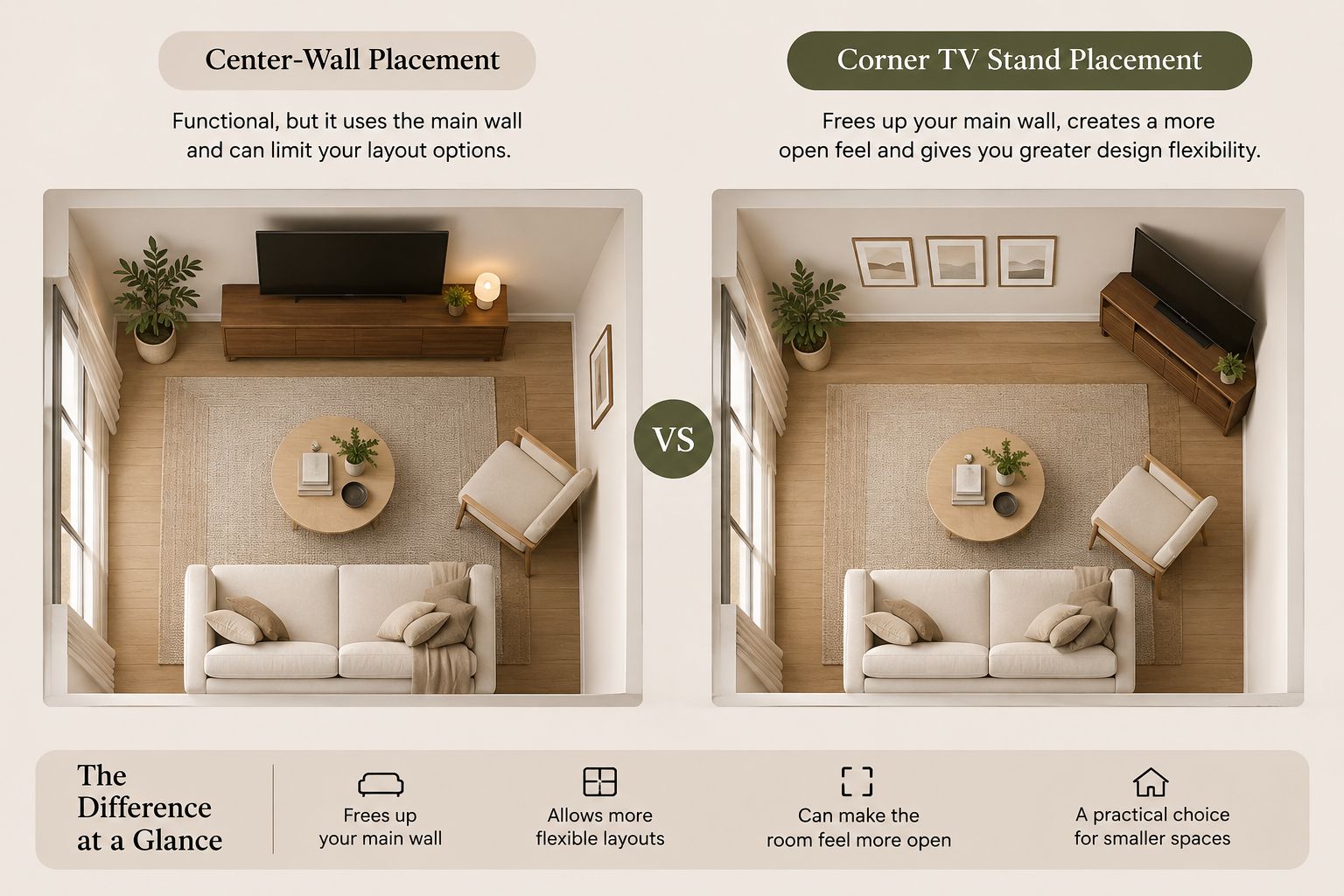
Open floor plans changed how people watch TV. The sofa is no longer pushed against a wall. Kitchen, dining, and living flow together. In that layout, a traditional center-wall TV placement can fight the room — it forces furniture to orient around it, and it eats a wall that could be art, built-ins, or windows.
A corner TV stand solves this three ways.
It opens up a wall. Your longest wall stays free for seating, gallery art, or a statement piece. In small apartments this matters more than anywhere else the single long wall is usually the most valuable surface in the room.
It expands viewing angles. Placed diagonally, the screen faces the whole room rather than one specific seat. For sectionals, this often works better than a wall-mounted TV that only angles well for the middle cushion.
It makes small rooms feel larger. Diagonals extend the visual depth of a corner, which pushes the room outward. A square room with a corner stand generally reads more spacious than the same room with a wall mounted TV.
For apartments, condos, lofts, and open-plan homes, the corner stand is often the more intentional choice.
The corner is usually the most underused surface in a modern living room — and the most honest place to put a TV.
How to size a corner TV stand correctly
Sizing is where most people make their first mistake. A stand that looks "about right" in a showroom often reads oversized or undersized in a real corner.
Match the stand width to your TV
Your TV shouldn't hang off the edges of the stand. The industry rule is simple — the stand should be at least as wide as the TV, and ideally about 6 inches wider on each side. A 55-inch TV (roughly 49 inches wide) sits best on a stand around 60 to 65 inches wide across the front face.
For corner stands specifically, pay attention to the front face width, not the total diagonal footprint. Many corner stands are listed by their rear corner-to-corner span, which overstates the usable top surface.
Measure your corner
Before you buy anything, measure three things:
| What to measure | Why it matters |
|---|---|
| Corner opening (wall-to-wall, two feet out from the corner point) | Determines maximum stand width |
| Depth the stand can extend into the room | Protects walkways, doorways, and seating paths |
| Baseboard clearance | Many corner stands have shaped rear panels that need the baseboard to end cleanly |
Most modern corner stands range 40 to 70 inches wide, with depths of 15 to 24 inches from the corner point.
Viewing height matters more than people realize
A TV placed too high turns watching into neck strain. The center of your screen should sit roughly at eye level when you're seated generally 40 to 48 inches from the floor. For a 55-inch TV (about 27 inches tall), that puts the base of the TV at 25 to 32 inches above the floor. Most quality TV stands land in this range.
If the stand is too short and the TV sits too low, you'll feel it within a week.
Material choices that define the look
Material tends to decide whether a corner TV stand reads modern, farmhouse, mid-century, or industrial — often more than the silhouette itself.
| Material | Best For | What to Watch For |
|---|---|---|
| Solid wood (oak, walnut, ash) | Warmth, texture, longevity | Printed-wood MDF ages badly wears at corners within a year |
| Metal frame (matte black, brushed brass) | Minimal, architectural, loft-leaning rooms | Metal-only can read cold look for wood tops to balance |
| Mixed wood and metal | Most modern apartments ages well | The safest "still current in 5 years" choice |
| Glass or cane accents | Styling layer, not structural | Thin rarely the main body of a good stand |
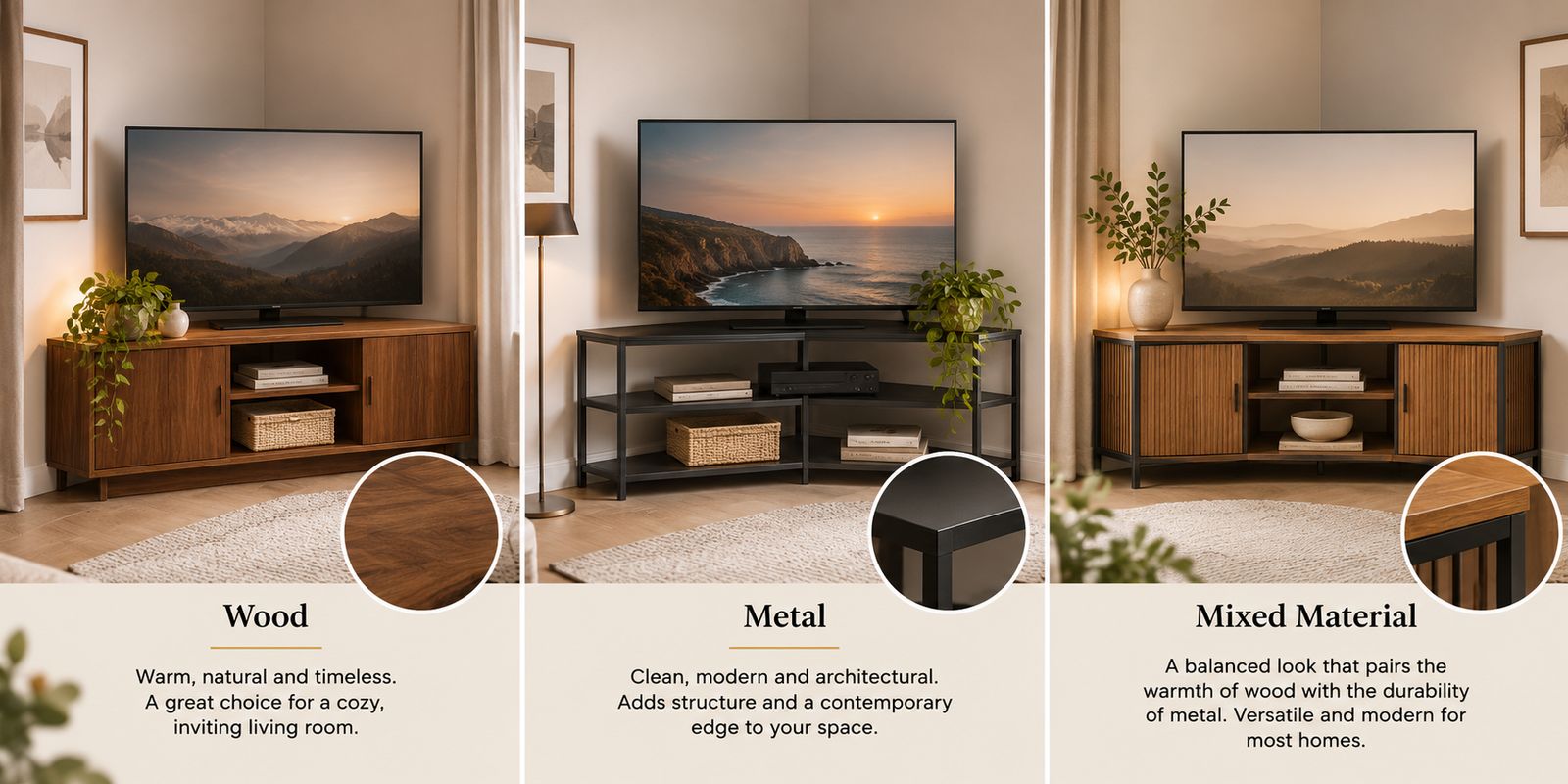
Wood. Oak, walnut, and ash are the three woods most associated with modern design right now. Lighter woods — white oak, ash — feel Scandinavian and open. Darker woods — walnut, stained oak — feel mid-century or masculine-modern. If the listing doesn't say "solid wood" or "real wood veneer," it's probably printed.
Metal. Powder-coated black or matte brushed brass frames read as minimal and architectural. They work well in lofts, industrial-leaning spaces, and homes where the goal is to make the furniture disappear so the TV and art take center stage. Metal-only can feel cold; most modern designs pair a metal frame with a wood top or shelves.
Mixed. A combination of wood, metal, and sometimes glass or cane has become the dominant modern aesthetic. These stands tend to age well because they borrow familiarity from the wood while staying crisp from the metal structure. A wood top on black or brass metal legs is the safest modern choice.
Styles that fit modern interiors
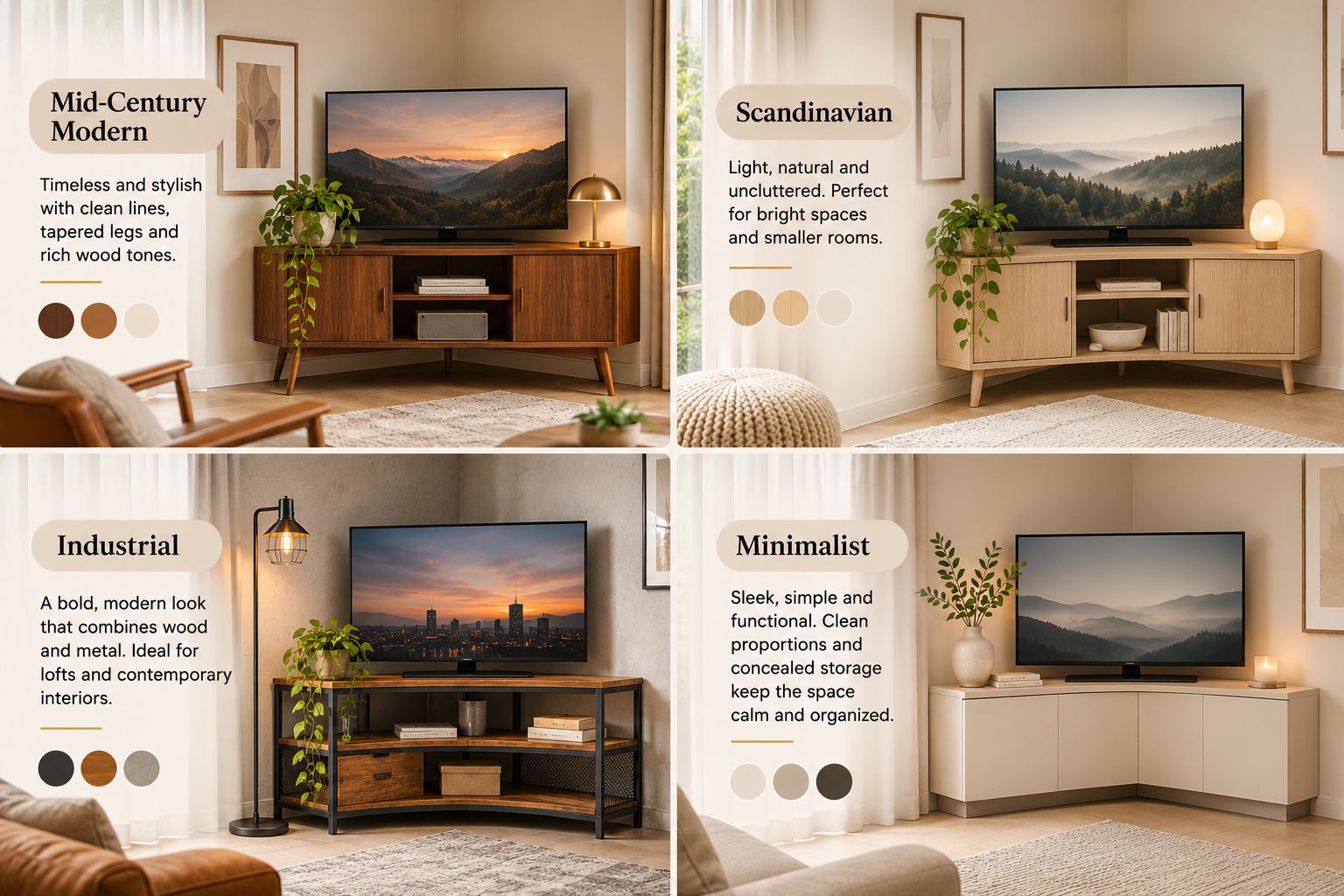
Modern isn't one look. These are the four variations that show up most often.
Mid-century modern. Low-slung profile, tapered legs, often walnut or teak. Works beautifully with curved-back sofas and warm neutral palettes. Best in rooms with 8-foot ceilings or higher, where the lower stand height gives the TV room to breathe.
Scandinavian. Light wood, white, soft curves, minimal hardware. Pairs with linen sofas, muted textiles, and plenty of natural light. The quietest of the modern looks — it tends to disappear into the room rather than announce itself.
Industrial. Black metal frame, reclaimed or dark wood, often with visible hardware. Works in homes with exposed brick, concrete floors, or high ceilings. Can feel heavy in smaller rooms, so proceed carefully in apartments.
Minimalist. Floating shelves, no visible legs, monochrome palette. Often wall-mounted rather than freestanding, which can be a smart option for corners if you have the wall studs to anchor into. Best for homes where the TV should recede visually.
The style you pick should match the sofa and rug you already own — not the Pinterest board you aspire to.
Storage: what you actually need
The temptation is to buy the stand with the most storage. In practice, most people fill the extra storage with things they could have thrown out.
Think about what actually lives next to your TV. A remote and small accessories need a shallow drawer or tray. A gaming console or soundbar needs an open shelf with ventilation — never a closed cabinet, because components overheat. A cable box needs the same, plus cable access. Books, decor, and candles fit on open shelves above or beside the main cabinet.
For most modern rooms, a corner stand with one or two drawers, one or two open shelves, and good cable routing is enough. Stands with six-plus drawers rarely earn their footprint.
A quiet room is a styled room with intention — not a stand loaded with doors hiding clutter.
Cable management is the detail everyone forgets
The difference between a corner TV stand that looks premium and one that looks assembled in a hurry is cable management.
Look for rear cutouts on every shelf so cables drop from the TV through to the console or cable box without wrapping around the frame. Look for a rear access panel or open back so you can reach cables without pulling the stand out from the wall. Look for cord channels or built-in cable runs along the legs — less common but excellent when present.
If the stand has a solid closed back with no cutouts, keep looking. You'll fight it forever.
Styling your corner TV stand
The stand is the base layer. What you put on and around it is what makes the corner feel designed rather than just furnished.
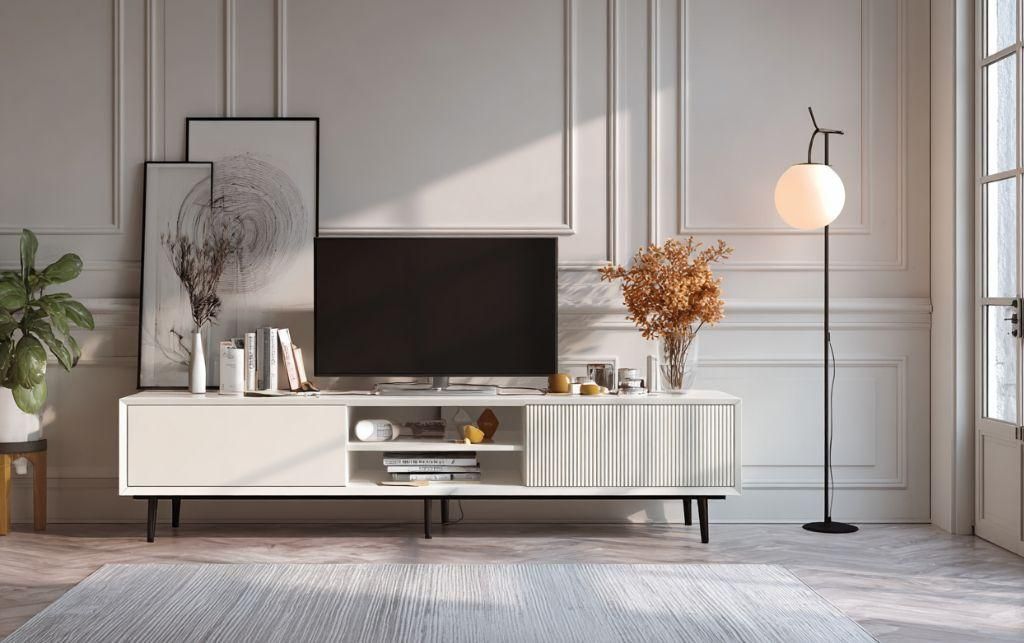
The top isn't storage. Keep it to one or two objects — a small sculptural lamp, a stack of two books, a ceramic vase. Resist the urge to fill it.
Layer height. If the stand has open shelves, alternate tall and short objects. A tall vase next to a flat book, next to a short candle. Repetition of shape makes a space feel flat.
Light the corner. A small table lamp or floor lamp nearby softens the TV's glow in the evening and makes the corner feel like part of the room when the TV is off. A slim pole floor lamp beside a corner TV stand reads as layered lighting rather than afterthought — our guide on where a floor lamp should go in a living room covers the "beside a console" placement in detail.
For the wall above or beside the stand, a single large piece of art reads more modern than a small gallery grouping.
Common mistakes to avoid
Buying a stand that's wider than the TV by 2 feet or more. The stand dominates the TV and makes the whole corner feel unbalanced. Scale up only if you're planning to upgrade the TV within a year.
Choosing a dark stand in a dark corner. Without a lamp or wall light, the TV becomes a glowing rectangle in a void. Lighter wood or warmer metals help. If the stand has to be dark, add a floor lamp nearby.
Ignoring the floor. A corner TV stand sits at the intersection of two rugs or floor transitions in open-plan homes. Make sure the base of the stand sits cleanly on one surface, not straddling two.
Buying for the TV you have, not the TV you'll have in three years. Most people upgrade TVs more often than furniture. Size the stand for a slightly larger screen than you own now.
Match the stand to the TV and the corner first, then narrow by material and finish.
Designer Tip
Before committing to a corner TV stand, tape the stand's footprint on the floor with painter's tape and sit in your usual spot for five minutes. If the stand reaches into a walkway, blocks a sight line, or feels too close to the sofa, you'll know immediately. Taping is five minutes of prevention that saves a return shipment.
Explore Modern Living Room Furniture
Browse the Zenvra Living Room Collection →
FAQ
How wide should a corner TV stand be for a 55-inch TV?
Generally 60 to 65 inches across the front face. The stand should be at least as wide as the TV (a 55-inch TV is about 49 inches wide) and ideally about 6 inches wider on each side. For corner stands, measure the front face width, not the total diagonal footprint.
How tall should a corner TV stand be?
Most corner TV stands land 24 to 32 inches tall. The goal is for the center of the TV screen to sit at eye level when you're seated — generally 40 to 48 inches from the floor. For a 55-inch TV, that puts the top of the stand at about 25 to 32 inches above the floor.
Are corner TV stands good for small living rooms?
Yes — corner TV stands often work better in small living rooms than center-wall stands. They free up the longest wall for seating or art, expand viewing angles for sectionals, and use the corner that would otherwise sit empty. In studios and one-bedrooms, the corner placement often reads more spacious.
What material is best for a modern corner TV stand?
Solid wood (oak, walnut, or ash) or mixed wood-and-metal stands read most modern and age best. Avoid printed-wood MDF, which wears at the corners within a year. Metal-only stands can feel cold without a wood top or shelves to balance them.
Do I need cable management built into a corner TV stand?
Yes. Rear cutouts on every shelf, an open back or rear access panel, and ideally cord channels along the legs are what separate premium corner stands from basic ones. A stand with a solid closed back and no cutouts is one you'll fight forever.
Should I wall-mount my TV instead of using a corner stand?
Depends on the room. Wall-mounting works when the sofa faces one wall at a single angle. A corner stand works better for sectionals, open-plan layouts, and rooms where the viewing angle needs to cover multiple seating positions. Wall-mounting also requires studs in the corner, which isn't always available in older apartments.
Bottom line
A modern corner TV stand works when the width matches the TV, the height puts the screen at eye level, the material matches the rest of the room, and the cable management is built in rather than retrofitted. Skip any one of those and the stand becomes the thing you keep noticing.
For most modern apartments, a 60 to 70 inch solid-wood or mixed-material stand with one or two drawers, open shelving for ventilated components, and rear cable cutouts handles a 55 to 65 inch TV cleanly. Pair it with a small lamp nearby so the corner feels intentional whether the TV is on or off.
Once the stand is right, the styling follows — one or two objects on top, layered heights on any open shelves, a single large piece of art above or beside rather than a gallery grouping.
Share this article